Training
On this page
The 5/3/1 Strength Program
Wayfit Editorial·
Jim Wendler developed 5/3/1 after getting tired of overly complicated programs that tried to do too many things at once. His response was a program built around four lifts, a simple monthly progression, and the idea that getting strong takes time and consistency, not novelty.
It's remained popular for years because it works. Not just for competitive powerlifters but for anyone who wants to build real strength and is willing to be patient about it.
The four lifts
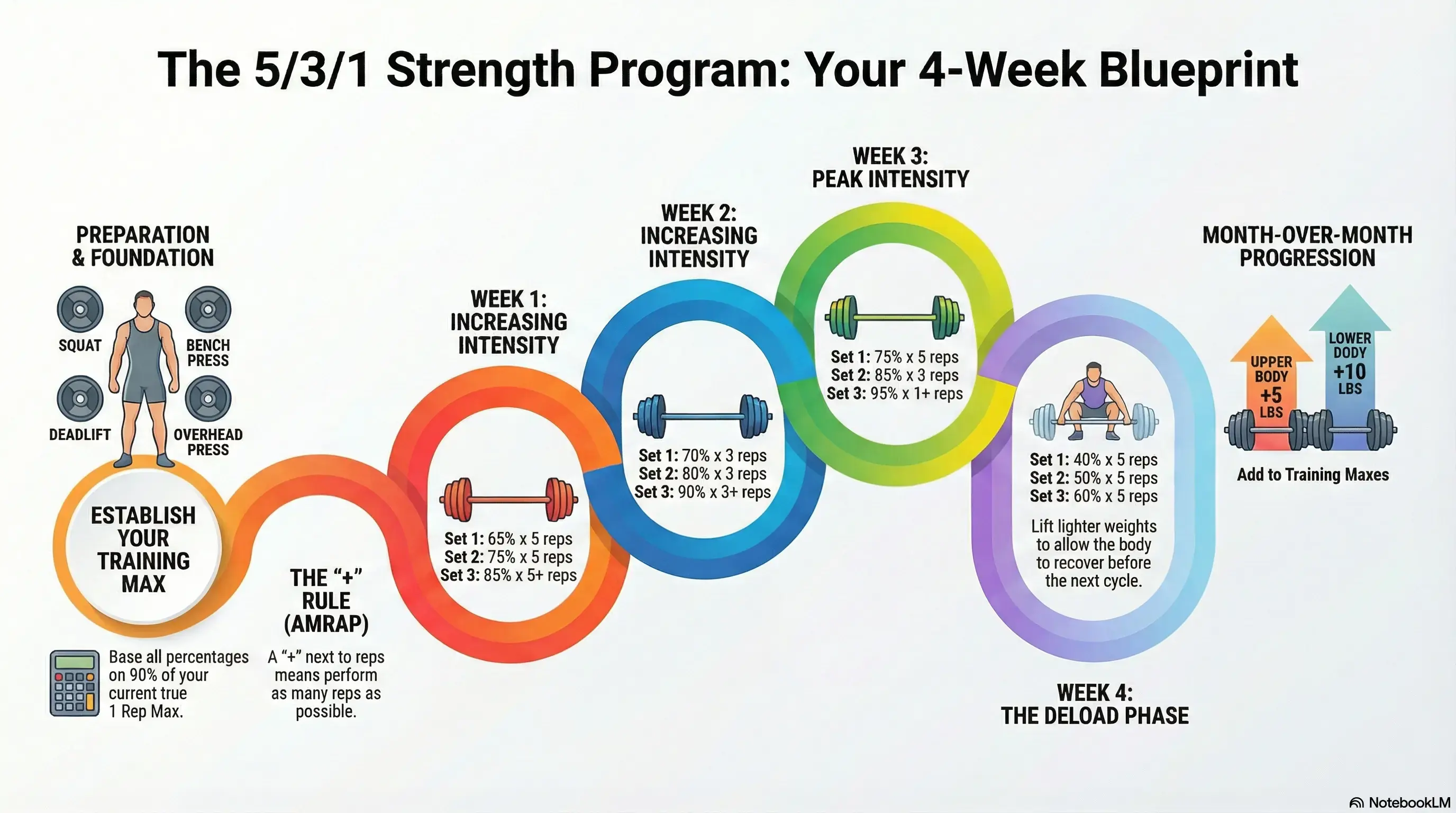
5/3/1 centers on four compound movements: the squat, the deadlift, the bench press, and the overhead press. Each is trained once per week. The program doesn't try to train everything at once, and the lift selection isn't arbitrary. These movements recruit the most muscle mass and produce the most strength transfer to other activities.
Assistance exercises are added around the main lifts, but they're secondary. The four main lifts are where the training effect comes from.
How the monthly wave works
Each month cycles through three training weeks followed by a deload week.
Week one: sets of five reps at progressively heavier weights, with the last set performed for five or more reps.
Week two: sets of three reps, heavier than week one, with the last set for three or more reps.
Week three: a descending set scheme (five reps, then three, then one) reaching the heaviest training weight of the cycle. The final set is again performed for as many reps as possible.
Week four is a deload. Lighter weights, same movement patterns, lower stress.
The "as many reps as possible" instruction on the final set of each session is where most of the real training intensity lives. That last set is not a test of your one-rep max. It's a controlled all-out effort within a submaximal framework.
The training max and why starting light matters
One reason the program works is that it's built on a "training max" rather than your actual one-rep maximum. You calculate everything off 90 percent of your true max. This keeps the weights manageable during the earlier weeks of each cycle, which allows for consistent training without grinding yourself into the ground.
Every month, you add five pounds to your upper body training maxes and ten pounds to your lower body maxes. These are small increases. Over several months they compound into meaningful strength gains without the burnout that comes from trying to add too much too fast.
Who it works for
5/3/1 is suited to beginners and intermediates who want to build strength without an overly complex program. It requires access to a barbell and either a rack or a gym. The time commitment is reasonable: four sessions per week, each lasting 45 to 75 minutes depending on how much assistance work you add.
It doesn't require you to max out frequently, doesn't ask you to train to failure on compound lifts, and doesn't change every few weeks. The simplicity is intentional. You add weight consistently over months and the strength follows.
The most common reason people fail with the program is not running it long enough. Give it at least three to four months before evaluating whether it's working.
Related articles
- Progressive Overload Explained — The principle that makes 5/3/1 work.
- How to Structure a Week of Exercise — Fitting four training days into a balanced week.
- Why Strength Matters More as You Get Older — Why building strength compounds over a lifetime.
This page is for education only and is not medical advice. If you have a medical condition or specific concerns, talk with a qualified healthcare professional.