
Metabolism
On this page
How Calorie Calculators Work
Wayfit Editorial·
Calorie calculators produce a number and it's easy to treat that number as precise. Put in your details, get your answer. But the number you get is an estimate built on a population-average formula, and your metabolism may differ from the average in ways that matter.
Understanding how these calculators work makes the output more useful rather than less.
The formula behind the number
Most calorie calculators start with something called basal metabolic rate: the number of calories your body burns at rest doing nothing but staying alive. The current standard formula for estimating this is the Mifflin-St Jeor equation, developed in 1990.
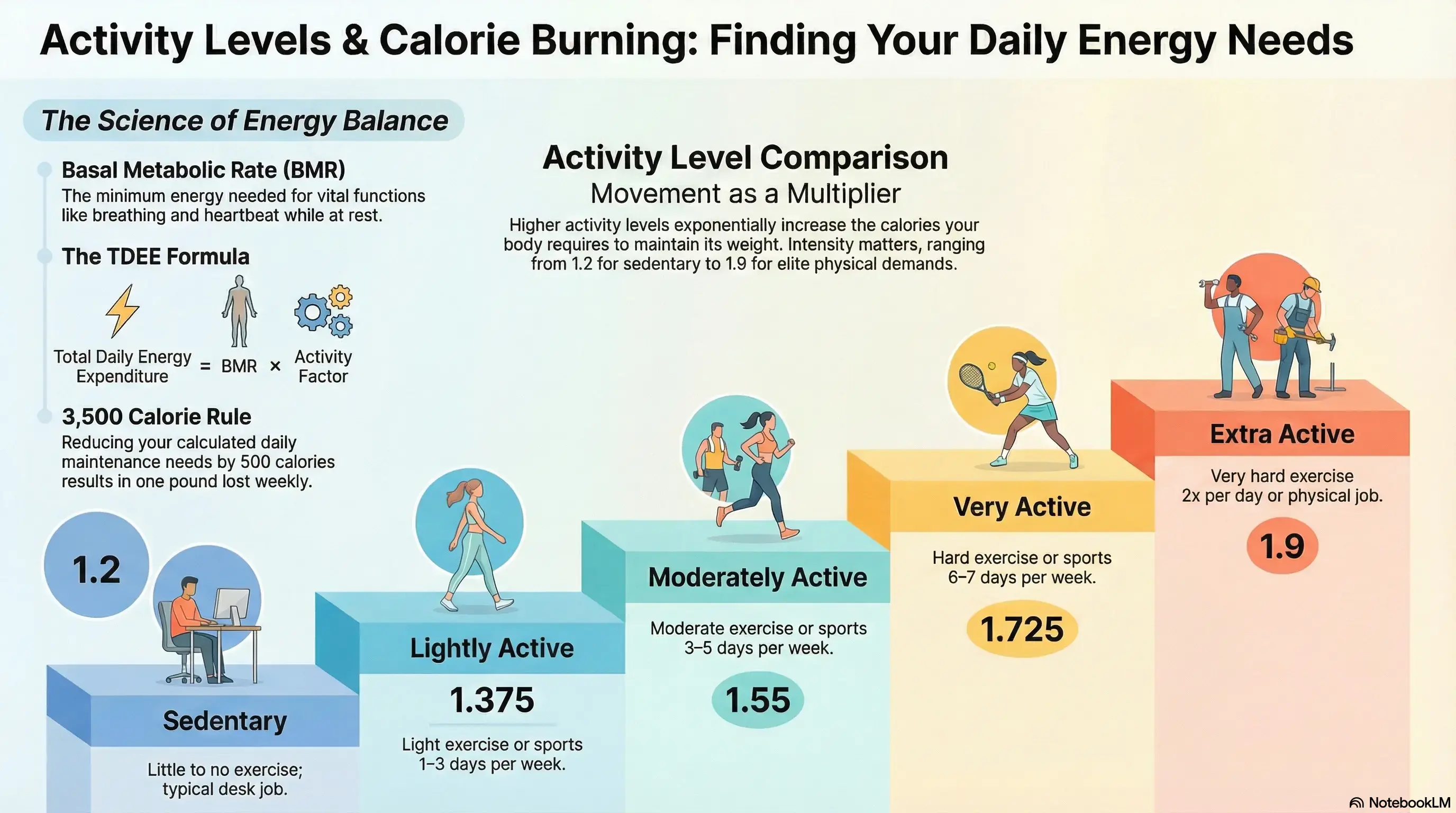
It takes four inputs: your weight, height, age, and sex. The result is an estimate of how many calories you'd burn lying still all day. From there, an activity multiplier adjusts the number based on how active you are. Someone sedentary gets a lower multiplier. Someone doing hard daily exercise gets a higher one.
The final number is your total daily energy expenditure: roughly how many calories you burn in a typical day.
Why the formula replaced an older one
The previous standard, the Harris-Benedict equation from 1919, was developed when the average person had a much more physically active lifestyle. It tends to overestimate calorie needs for people with modern sedentary jobs. Mifflin-St Jeor was developed using a more contemporary population and provides better estimates for most people today.
Neither equation is exact. Both are estimates derived from averages.
The margin of error matters
Calorie calculators carry a margin of error of roughly 10 to 15 percent. For someone whose calculator says they burn 2,000 calories per day, the actual number could reasonably be anywhere from about 1,700 to 2,300 calories.
This matters when you're planning a deficit. If your true burn is at the low end of the range and you eat at what you think is a 500-calorie deficit, you might actually be eating at maintenance or close to it.
How to treat the output
Use the calculator number as a starting point, not a conclusion. Track your food intake reasonably accurately for two to three weeks while eating at the number the calculator gives you for maintenance or your intended deficit. Then look at what your weight actually did.
If you're not losing weight at the expected rate, reduce your intake by 100 to 200 calories and reassess after another two to three weeks. If you're losing faster than seems healthy or sustainable, eat a little more.
The calculator doesn't know your specific metabolism. Your results do. The formula gives you an educated starting point. Actual observation over several weeks tells you what's true for you.
Activity multipliers are imprecise too
The activity multipliers used in most calculators are broad categories: sedentary, lightly active, moderately active, very active. People's actual activity levels vary continuously and are often hard to estimate accurately. Many people overestimate how active they are, which leads to a higher calculated burn than is real.
When in doubt, use the lower activity multiplier and adjust upward based on results rather than starting high and wondering why the scale isn't moving.
Related articles
- Understanding Calorie Deficit — How to use your estimated TDEE to plan a deficit.
- What BMI Misses — Why body composition matters more than weight alone.
- Calorie Cycling: Does Varying Your Intake Help? — A different approach to structuring intake.
This page is for education only and is not medical advice. If you have a medical condition or specific concerns, talk with a qualified healthcare professional.