
Activity & Guidelines
On this page
Why Everyday Movement Matters Beyond Your Workouts
Wayfit Editorial·
Most conversations about physical activity focus on workouts. How long, how hard, how often. The exercise session is the main event.
But there's a category of physical activity that typically adds up to more calories than any workout, shapes your metabolism, and declines dramatically when people switch to sedentary lifestyles. It's called NEAT, and it's something most people have never heard of despite relying on it every day.
What NEAT is
NEAT stands for non-exercise activity thermogenesis. It's all the movement you do that isn't structured exercise: walking to the kitchen, fidgeting, standing up, climbing stairs, doing chores, pacing during a phone call, reaching across a table.
None of these movements are intense. Each one burns a small number of calories. But they happen throughout every waking hour, and when you add them up across a day, they can account for several hundred to over a thousand calories in daily energy expenditure.
Research from the Mayo Clinic, led by Dr. James Levine, identified NEAT as a primary variable distinguishing lean from obese individuals in controlled conditions. When people were given identical calorie-controlled diets, those who naturally moved more throughout the day (more walking, more standing, more fidgeting) gained significantly less weight. The differences were not from the gym. They were from daily movement patterns.
Why it matters for your metabolism
Total daily energy expenditure has four components: basal metabolic rate (calories burned at rest), the thermic effect of food (energy used to digest meals), structured exercise, and NEAT.
In most people who do not exercise at a high volume, NEAT is the largest variable component of total daily expenditure. It can vary by as much as 2,000 calories per day between individuals with different lifestyle patterns, according to research published in Science.
This variation matters because it changes the equation for weight management considerably. Two people eating the same diet and doing the same structured exercise can have meaningfully different energy balances based purely on how much they move during the rest of the day.
The problem with modern life is that sedentary work, car-dependent commuting, and screen-based entertainment compress NEAT dramatically. Where a person walking between destinations in a city might accumulate 8,000 to 12,000 steps in a day without trying, someone driving to and from a desk job might finish the day with 2,000 to 3,000.
That difference is roughly 300 to 500 calories, every day, without a single workout.
The office problem
Sedentary work has replaced active work for a large portion of the population. Factory workers, trades people, and agricultural workers once had high-NEAT jobs by design. Knowledge workers spend most of their professional hours seated, often for eight or more consecutive hours.
One irony of this is that exercise session duration doesn't fully compensate for the loss of movement throughout the day. A 45-minute workout at the gym is a meaningful intervention, but it doesn't add back the movement that would have occurred across the other 15 waking hours in a higher-NEAT lifestyle.
This is part of why researchers studying the "active couch potato" effect have found that people who meet exercise guidelines but are otherwise sedentary still show elevated metabolic and cardiovascular risk compared to people who are consistently active throughout the day.
Practical ways to increase NEAT
The goal isn't to manufacture fake busyness. It's to notice where movement has been designed out of your day and add it back where it fits.
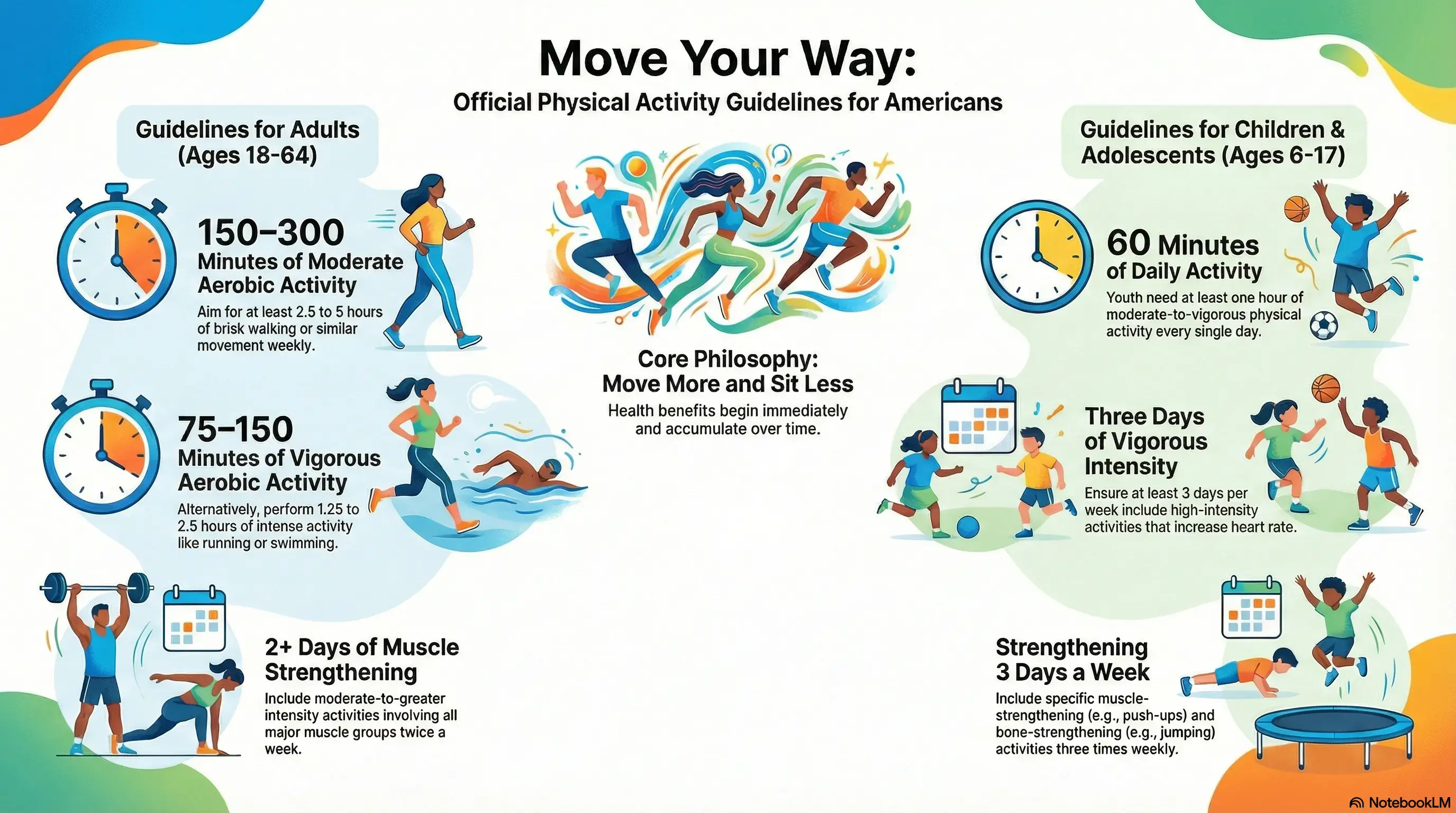
Walking is the most accessible NEAT behavior. Walking meetings, walking during phone calls, walking to do errands instead of driving when possible. A 15-minute walk at lunch and another after dinner adds up to real movement without requiring gym time.
Stairs over elevators and escalators. Standing during transit where available. Parking farther from the destination. These are small choices that, made consistently, produce a different daily movement total.
For people who work at desks, the research on brief activity breaks is useful. Short walks or standing intervals every 30 to 60 minutes interrupt the metabolic effects of prolonged sitting and add incidental movement that accumulates over the course of a workday.
Household activity counts. Cooking from scratch, cleaning, gardening, DIY projects. These are NEAT behaviors that also get other things done.
The honest number
For most people trying to manage weight or improve health, structured exercise is useful but not sufficient on its own. The total picture includes everything that happens in the remaining 23 hours.
NEAT doesn't replace deliberate exercise. They do different things. But bringing your daily movement total up through more incidental activity can make more difference to your overall energy balance than adding another workout.
The simplest target is steps. Research consistently shows that higher daily step counts, independent of structured exercise, are associated with better metabolic health and lower mortality risk. A goal of 7,500 to 10,000 steps per day captures a meaningful amount of NEAT and is achievable without a gym.
What you do between workouts is not nothing. It might be more important than the workouts themselves.
Related articles
- Why Sitting All Day Is a Problem Even If You Exercise — How prolonged sitting counteracts an active lifestyle.
- Where the 10,000 Step Goal Comes From — How daily step targets capture NEAT.
- How Activity Needs Change as You Age — Movement recommendations across life stages.
This page is for education only and is not medical advice. If you have a medical condition or specific concerns, talk with a qualified healthcare professional.